
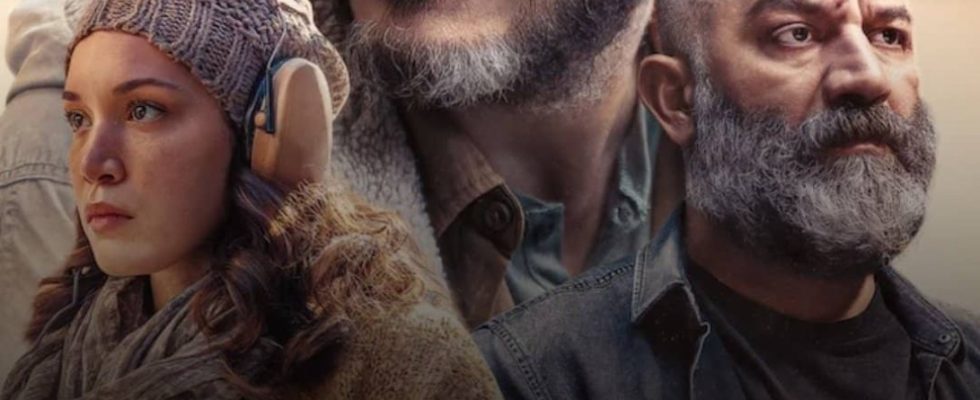
Greetings, fellow enthusiasts! Are you ready to dive into a thrilling review of the captivating series Hot Skull? This Turkish miniseries delivers a mesmerizing blend of sci-fi and dystopian elements, showcasing a reality where the very act of speaking can prove fatal, transforming communication into a challenge for survival.
Advertisements
Premiering on December 2, 2022, Hot Skull (also known as “Sıcak Kafa” in Turkish) is an eight-episode Netflix original, each episode spanning around 45-50 minutes. Brought to life by the creative minds of Mert Baykal and Umur Turagay, the series features standout performances by Osman Sonant, Şevket Çoruh, Hazal Subaşı, and Tilbe Saran, who navigate this linguistically charged dystopia with incredible depth.
Hot Skull brilliantly intertwines elements of psychological thrillers, dystopian fiction, and poignant social critique, crafting a thought-provoking narrative. It delves into the disintegration of communication, the grips of authoritarianism, and the inherent power of language within our society. This striking Turkish series dares to tread where few have before, spotlighting a world where words can both liberate and annihilate, creating a story that is refreshingly unique in the realm of television.
In a Realm Where Language Becomes Lethal
Set against the backdrop of a ravaged future, the series explores a society plagued by a devastating affliction—”babble”—that spreads through speech and drives individuals to insanity. The narrative follows Murat, a linguist who unexpectedly discovers his immunity to this disastrous condition, marking him as both a coveted ally and a perilous quarry for authoritarian forces determined to manage the chaos.
In this chilling reality, mere words can lead to dire consequences, compelling survivors to adopt silence or a strictly monitored form of communication. As Hot Skull advances, Murat embarks on a perilous journey to uncover the reasons behind his immunity and the true origins of the epidemic that has upended life as we know it.
Murat: The Weight of Being Unique
Osman Sonant shines as Murat, capturing the essence of a man whose transformation from a reclusive scholar to a key player in a crumbling world is both riveting and relatable. Throughout Hot Skull, Murat grapples with the loneliness stemming from his distinction and the heavy ethical burden that comes with his rare immunity in a society where communication has been turned into a weapon.
His character’s arc poignantly touches on survivor’s guilt, social accountability, and the mental strain of existing in a reality where human interactions have been irrevocably altered. Murat’s journey—shifting from hesitant survivor to reluctant leader—underscores the series’ insight into how ordinary individuals can rise to unexpected challenges, even when they resist their newfound roles.
Oppression and the Fight for Freedom
The supporting cast, led by Şevket Çoruh, skillfully weaves a complex tapestry of characters, each representing diverse strategies for navigating the aftermath of the linguistic apocalypse. Hot Skull introduces various factions: the oppressive regime attempting to control the chaos, freedom fighters resisting tyranny, and everyday survivors striving just to make it through in an increasingly perilous landscape.
These characters enhance the series’ exploration of human responses to existential peril—while some cling to authoritarian control, others champion rebellion, and many simply focus on survival, creating a rich narrative filled with diverse human experiences.
Unveiling the Epidemic: Truth and Turmoil
The tension peaks as Murat begins to unravel the true roots of the babble epidemic and the conspiracy fueling its spread. Hot Skull intensifies as he realizes that his immunity may hold the key not just to endurance but also to potentially reversing the linguistic catastrophe that has shattered civilization.
These climactic moments exemplify the series’ knack for merging personal stakes with broader societal implications. The unveiling of how language became a weapon—and by whose design—offers both hope for salvation and a deeper understanding of the systematic dismantling of human communication, paving the way for confrontations that will shape humanity’s future.
Netflix’s Bold Offering
Hot Skull has carved out a niche on Netflix by presenting a groundbreaking narrative that diverges from mainstream offerings. Its inventive premise—depicting language as both a contagion and a remedy—set it apart, although it ultimately did not secure a second season. With stellar performances from Osman Sonant and Şevket Çoruh, striking cinematography, and profound themes on communication and governance, Hot Skull established itself as a thought-provoking addition to Netflix’s international sci-fi portfolio, earning acclaim for its originality despite its short lifespan.
An Unmissable Dystopian Journey
If you’re a fan of dystopian tales that push boundaries and delve deep into psychological realms, look no further than Hot Skull—a must-watch for your Netflix binge list.
Why This Intriguing Concept Deserves Attention
What Works:
- An entirely innovative premise that examines language as both a tool of devastation and a means of salvation.
- Osman Sonant’s compelling portrayal of a layered hero faced with impossible dilemmas.
- Stimulating social insights regarding communication, governance, and human interaction.
- Impressive world-building that authentically depicts a terrifying post-apocalyptic Istanbul.
- Sophisticated writing that engages viewers with complex philosophical issues.
What Could Improve:
- The pacing may be slow, potentially challenging those hoping for action-driven sci-fi.
- Some intricate linguistic ideas might be tricky for casual viewers to grasp.
- Certain plot points could feel hurried due to the eight-episode limitation.
- The bleak themes might be too heavy for some audiences.
- Cultural nuances may be lost on international viewers not familiar with Turkish language intricacies.
Hot Skull presents a rare opportunity in television, merging innovative sci-fi ideas with relevant social commentary—making it essential viewing for anyone in search of a thought-provoking dystopian narrative that challenges traditional perspectives on communication and society.
Series Overview
- Episode Count: 8 episodes (1 season – cancelled)
- Available On: Netflix
- Year of Release: 2022
- IMDb Rating: 7.1/10
- Genres: Science Fiction, Dystopian Thriller, Drama, Mystery
- Production Type: Turkish Drama (Dizi)
- Status: Cancelled after one season
- Main Characters: Osman Sonant (Murat), Şevket Çoruh (Anton), Hazal Subaşı (Yasemin)
- Adversaries: The oppressive regime and the linguistic epidemic endangering humanity